Aluminum Gauge Chart
Look up aluminum sheet thickness by gauge in inches and mm, or type a decimal thickness to find the nearest gauge.
At a glance
Aluminum Gauge Chart is a free browser tool that converts aluminum sheet gauge numbers to thickness in inches and mm, with weight per ft² and m², and finds the nearest gauge for a given thickness.
- Converts aluminum gauge numbers to thickness in inches and mm, with weight in lb/ft² and kg/m².
- Finds the nearest gauge for a thickness entered in mm or inches.
- Uses the Brown & Sharpe gauge; 16 gauge aluminum is 0.0508 inch (1.291 mm).
- Full chart runs from gauge 0 (0.3249 in) to gauge 30.
- Free, runs in the browser, with no installation or sign-up.
- Weight figures use 6061's density of 2.70 g/cm³.
Sources: Sheet metal (Wikipedia) (checked 2026-10-15) · American wire gauge (Wikipedia) (checked 2026-10-15) · Material density chart (AIMS Industrial) (checked 2026-10-15)
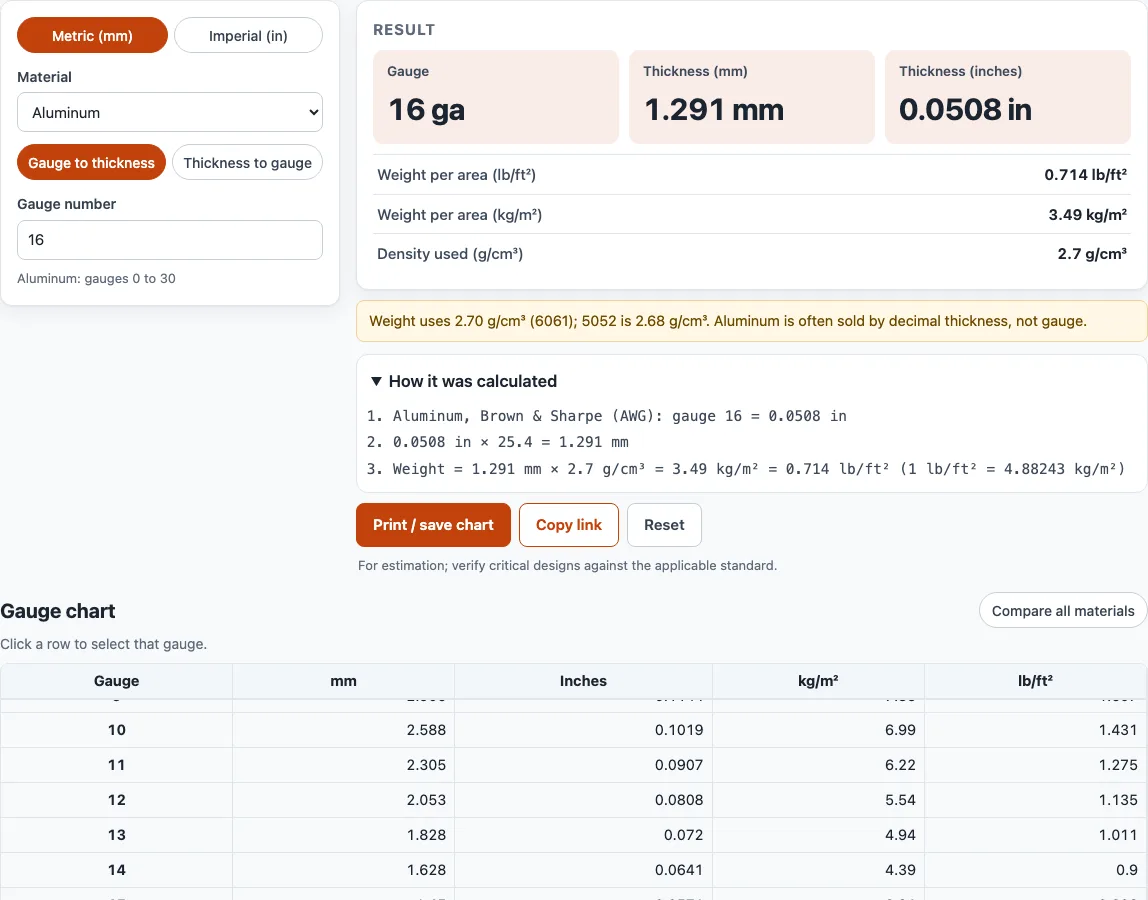
How to use the aluminum gauge chart converter
- Check that Material is set to Aluminum. This page opens with it selected. Change it only if you need another metal.
- Choose a mode: Gauge to thickness or Thickness to gauge.
- For Gauge to thickness, type a gauge number such as 16. The result shows the thickness in inches and mm, plus the weight in lb/ft² and kg/m².
- For Thickness to gauge, type a thickness in mm or inches. The result shows the nearest gauge, the difference, and the next nearest gauge.
- Use the Metric (mm) / Imperial (in) switch at the top to change units.
- Scroll the chart below the converter. Click any row to select that gauge.
Use Compare all materials to see one table with the thickness of every material side by side for each gauge number.
Print / save chart prints your inputs, the result, the calculation steps, the date and the full aluminum chart as a clean table. Use your browser’s Save as PDF option to keep a copy. Results, charts and printouts are free to use in commercial work such as quotes, client jobs and products, with no attribution required. Copy link creates a link that reopens the page with the same inputs. Reset clears the entries.
What thickness is 16 gauge aluminum?
16 gauge aluminum is 0.0508 inch (1.291 mm) thick. Aluminum sheet uses the Brown & Sharpe gauge, also called American Wire Gauge (AWG), which has the formula thickness = 0.005 × 92^((36 − n)/39) inches, where n is the gauge number.
At 2.70 g/cm³, 16 gauge aluminum weighs 0.714 lb/ft² (3.49 kg/m²). That is about a third of steel of the same thickness. Remember that gauge numbers run backwards: a higher number means thinner sheet.
Is aluminum gauge the same as steel gauge?
No. The same gauge number gives a different thickness in each material because each material follows a different gauge standard. At 16 gauge, steel is 0.0598 inch (1.519 mm) and aluminum is 0.0508 inch (1.291 mm).
Steel uses the Manufacturers’ Standard Gauge, which is defined by weight: 41.82 lb per square foot for each inch of thickness. Aluminum uses the Brown & Sharpe formula above. Always check which material a gauge chart is for before you order or cut.
How do you convert aluminum gauge to thickness?
Look up the gauge number in the chart, or apply the Brown & Sharpe formula. For a thickness you already have, work in reverse: find the gauge whose thickness is closest to it. For example, 2 mm aluminum is closest to 12 gauge, which is 2.053 mm. The difference is 0.053 mm, and the next nearest gauge is 10 gauge at 2.588 mm.
Check the unit before you compare. Aluminum sheet is often sold by decimal thickness rather than by gauge, so a supplier’s listing may give 0.064 inch instead of “14 ga.” Compare the decimal numbers directly when you can.
Aluminum sheet thickness chart: common gauges
Each step in the Brown & Sharpe system changes the thickness by about 12.3% (the ratio 92^(1/39)), so the thickness roughly doubles every six gauges: 16 gauge is 0.0508 in and 10 gauge is 0.1019 in. These are the aluminum sheet gauges you will meet most often:
| Gauge | Inches | mm | lb/ft² (6061) |
|---|---|---|---|
| 8 | 0.1285 | 3.264 | 1.805 |
| 10 | 0.1019 | 2.588 | 1.431 |
| 12 | 0.0808 | 2.053 | 1.135 |
| 14 | 0.0641 | 1.628 | 0.900 |
| 16 | 0.0508 | 1.291 | 0.714 |
| 18 | 0.0403 | 1.024 | 0.566 |
| 20 | 0.0320 | 0.812 | 0.449 |
| 22 | 0.0253 | 0.644 | 0.356 |
| 24 | 0.0201 | 0.511 | 0.282 |
The full chart in the tool runs from gauge 0 (0.3249 in) to gauge 30.
Sources
Data and rules used by this tool (checked October 2026):
Frequently asked questions
What gauge is 1/8 inch aluminum?
1/8 inch (0.125 in, 3.175 mm) aluminum is closest to 8 gauge, which is 0.1285 in (3.264 mm) in the Brown & Sharpe system. Thick aluminum like this is normally ordered by decimal thickness rather than by gauge.
How thick is 14 gauge aluminum?
14 gauge aluminum is 0.0641 inch (1.628 mm) thick and weighs about 0.900 lb/ft² (4.39 kg/m²) at 2.70 g/cm³.
Does this chart work for 5052 aluminum?
Yes, the thickness values are the same for any aluminum alloy using the Brown & Sharpe gauge. The converter’s weight figures use 6061’s density of 2.70 g/cm³. 5052 is 2.68 g/cm³, so its weight is about 0.7% lower than the result shown.
Is aluminum sold by gauge or by decimal thickness?
Both are common. Aluminum sheet is often sold by decimal thickness, such as 0.125 inch, rather than by gauge. Use the chart to convert between the two before you order.
Why is aluminum gauge thinner than steel gauge at the same number?
Because the two use different standards. Aluminum follows the Brown & Sharpe wire gauge, while steel sheet follows the Manufacturers’ Standard Gauge, which is based on weight. At 10 gauge, aluminum is 0.1019 in and steel is 0.1345 in.
Can I print the aluminum gauge chart?
Yes. Click Print / save chart to print the full aluminum chart with your current result and the calculation steps, or choose Save as PDF in the print dialog to keep a copy for the workshop.
Related tools
- Sheet metal gauge chart: Compare gauge thicknesses across metals when you have not picked a material yet.
- Stainless steel gauge chart: Use this when your sheet is stainless, which follows a different gauge standard.
- Galvanized steel gauge chart: Use this for zinc-coated steel, whose thickness includes the coating.
- Steel plate weight calculator: Estimate the weight of a steel plate once you know its size and thickness.
- Metal weight calculator: Estimate the weight of metal parts across different materials.
- Bend allowance calculator: Find how much material a bend uses, so your flat pattern is accurate.
- Laser cutting cost calculator: Estimate what it costs to laser cut a part from your sheet.
- Bend radius calculator: Check the bend radius you need for a given sheet thickness.