Angle Iron Weight Calculator
Enter the two leg sizes, the thickness and the length of an angle to get its weight per foot or metre and per piece.
At a glance
Angle Iron Weight Calculator is a free browser tool that works out the weight of an L-shaped steel or aluminum angle from its leg sizes, thickness, length and material, per piece and per metre or foot.
- The tool is free, runs in your browser, and needs no sign-up.
- Weight is calculated from leg sizes, thickness, length and material density.
- Thickness must be smaller than both legs, or the tool shows an error.
- Steel density is 7.85 g/cm³; stainless 304 or 316 is 8.00 g/cm³; aluminum 6061 is 2.70 g/cm³.
- The tool ignores the rounded root fillet and toe radius, so results are typically within about 1.5 % of AISC shape data.
- Results are for estimation; check critical designs against the applicable standard.
Sources: Structural steel (Wikipedia) (checked 2026-10-15) · Material density chart (AIMS Industrial) (checked 2026-10-15)
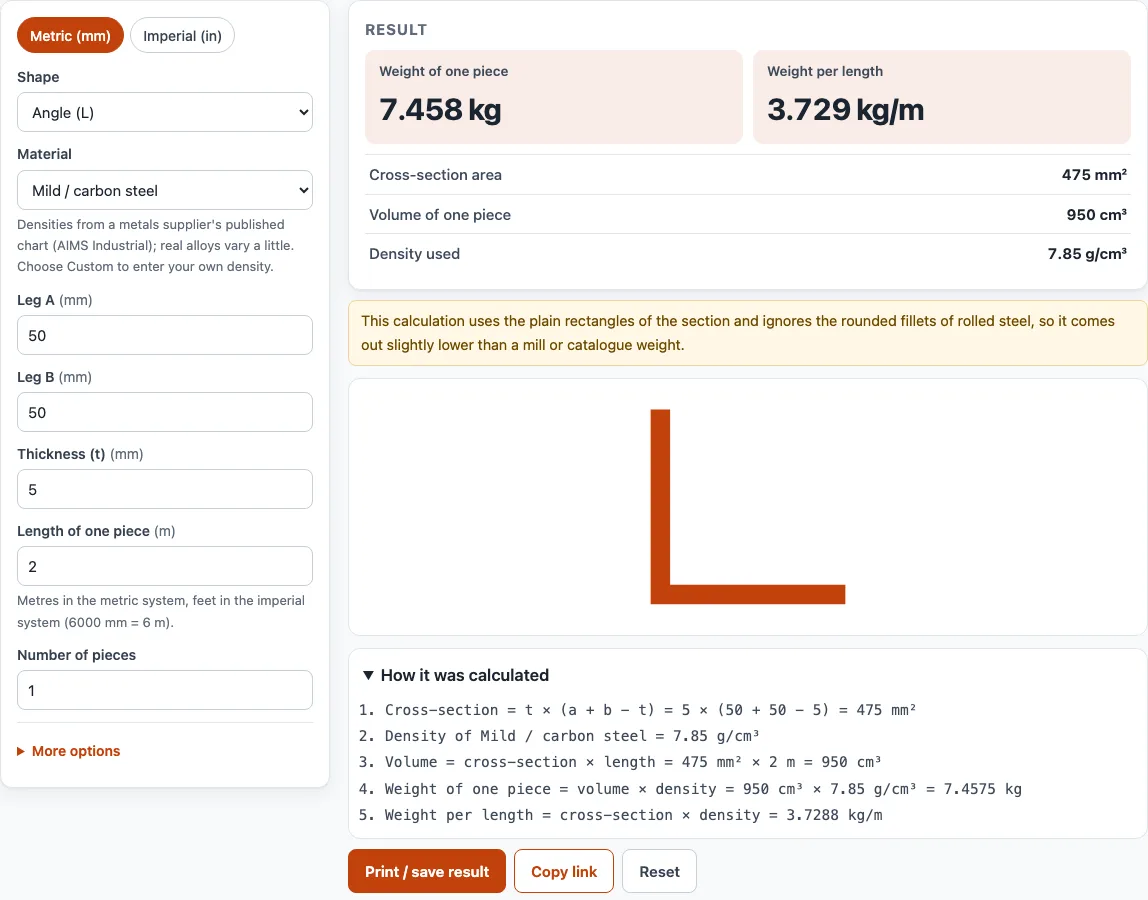
How to use the angle iron weight calculator
- Pick your units with the Metric (mm) / Imperial (in) switch at the top of the tool.
- Choose a material from the Material list, such as Mild / carbon steel. For anything not listed, choose Custom density and type its density.
- Enter Leg A and Leg B. For an equal angle, use the same value for both legs. For an unequal angle, enter different values.
- Enter the Thickness (t). It must be smaller than both legs, or the tool shows an error.
- Enter the Length of one piece.
- Enter the Number of pieces. When this is more than 1, the tool also shows the Total weight.
- Optional: open More options and enter a Price per kg (metric) or per lb (imperial) to add a material cost.
- Read the results: Weight of one piece, Weight per length (kg/m or lb/ft), Cross-section area, Volume of one piece and Density used. The cross-section sketch and calculation steps are shown too.
Under the result, Print / save result prints the inputs, results, calculation steps and date. Use your browser’s Save as PDF option to make a PDF. Copy link reopens the page with the same inputs, which is handy for sending a job to someone else. Reset clears the form so you can start a new calculation.
What is the steel angle weight formula?
The weight of a steel angle is its cross-section area multiplied by its length and by the material’s density. The cross-section area is t × (A + B − t), where A and B are the two legs and t is the thickness, all in the same unit.
Steel has a density of 7.85 g/cm³, which is 7,850 kg/m³ or 0.2836 lb/in³. For a 50 × 50 × 5 mm angle, the area is 5 × (50 + 50 − 5) = 475 mm². Multiplying by 1 m of length gives 475,000 mm³, or 475 cm³. At 7.85 g/cm³ that is 3,729 g, so the angle weighs 3.729 kg/m. Over a 6 m length, that is 22.37 kg.
How do you calculate the weight of an unequal angle?
Use the same formula, with the two different leg lengths in place of A and B. The subtraction of t is needed because the thickness is counted in both legs, and the corner square where they meet would otherwise be counted twice. Removing t once takes out that square.
For a 75 × 50 × 6 mm unequal angle, the area is 6 × (75 + 50 − 6) = 714 mm². That gives 5.605 kg/m, or 33.63 kg for a 6 m piece. The same steps work for any leg sizes, as long as the thickness is smaller than both legs.
How close is the result to AISC shape tables?
The tool ignores the rounded root fillet and toe radius of rolled angles. In practice, the result is typically within about 1.5 % of the AISC shapes data for common sizes. For example, an L4×4×1/2 in angle gives 12.76 lb/ft, against a table value of 12.8 lb/ft. An L6×6×1/2 gives 19.57 lb/ft, against 19.6 lb/ft.
That difference is small for ordering, costing and planning. For load-bearing or safety-critical work, confirm the section properties and weights against the applicable standard.
Angle weight chart
Weight of steel angle in lb per foot, with the weight listed in the AISC shapes data (as tabulated by AmesWeb) next to the tool’s value. The tool leaves out the rounded root and toe, so it is a little lower:
| Angle (in) | AISC table, lb/ft | Tool, lb/ft | Difference |
|---|---|---|---|
| L2½×2½×¼ | 4.10 | 4.04 | -1.4 % |
| L3×3×¼ | 4.90 | 4.89 | -0.2 % |
| L3×3×⅜ | 7.20 | 7.18 | -0.3 % |
| L4×4×¼ | 6.60 | 6.59 | -0.1 % |
| L4×4×½ | 12.80 | 12.76 | -0.3 % |
| L5×3×¼ | 6.60 | 6.59 | -0.1 % |
| L6×6×½ | 19.60 | 19.57 | -0.2 % |
| L8×8×1 | 51.00 | 51.05 | 0.1 % |
Metric angles, weight per metre from the tool (steel 7.85, aluminum 6061 2.70 g/cm³):
| Angle (mm) | Steel kg/m | Aluminum 6061 kg/m |
|---|---|---|
| 25 × 25 × 3 | 1.107 | 0.381 |
| 40 × 40 × 4 | 2.386 | 0.821 |
| 50 × 50 × 5 | 3.729 | 1.282 |
| 63 × 63 × 6 | 5.652 | 1.944 |
| 75 × 75 × 6 | 6.782 | 2.333 |
| 100 × 100 × 8 | 12.058 | 4.147 |
| 75 × 50 × 6 | 5.605 | 1.928 |
| 100 × 75 × 8 | 10.488 | 3.607 |
Sources
Data and rules used by this tool (checked October 2026):
Frequently asked questions
Does the angle iron weight calculator work for stainless steel and aluminum?
Yes. Choose Stainless steel 304 or 316 (8.00 g/cm³) or Aluminum 6061 (2.70 g/cm³) from the Material list. A 40 × 40 × 4 mm aluminum 6061 angle that is 3 m long weighs 2.46 kg.
What does L3×3×1/4 mean?
It is an angle with two 3 in legs and a thickness of 1/4 in. Enter 3 for Leg A, 3 for Leg B and 1/4 for Thickness (t) in Imperial units.
How much does 20 ft of 2 × 2 × 1/4 in steel angle weigh?
A 2 × 2 × 1/4 in steel angle weighs 3.190 lb/ft, so 20 ft weighs 63.81 lb. Set the Length of one piece to 20 ft to get this result.
Can I use this tool for channel or I-beam sections?
This page covers angles only. For channel and I-beam sections, use the other shapes in the same tool or the steel beam weight calculator.
Does the result include the rounded corner of a rolled angle?
No. The tool uses the plain two-leg shape, so it comes out a little lower than the weight in a mill table. The chart above shows how close it gets for common sizes.
Can I use the results in commercial work?
Yes. Results and files can be used in quotes, client jobs and products you sell, royalty-free, with no attribution required. The only limit is copying the site itself as a competing service.
Related tools
- Metal weight calculator: use it to weigh shapes or materials beyond angle iron.
- Steel beam weight calculator: use it for I-beam and other beam sections.
- Tube weight calculator: use it to weigh hollow square and rectangular tube.
- Round bar weight calculator: use it to weigh solid round bar.
- Steel plate weight calculator: use it to weigh flat plate by thickness and area.
- Pipe weight calculator: use it to weigh pipe by NPS size and schedule.
- Sheet metal gauge chart: use it to look up sheet thickness by gauge number.