K-Factor Calculator
Estimate the sheet metal K-factor from thickness, inside radius and bending method, or work it out from a test bend.
This K-factor calculator estimates the sheet metal K-factor, which is the position of the neutral axis inside a bend, from your material thickness, inside bend radius, bending method and material type. It runs in your browser for free, with nothing to install and no sign-up.
The tool uses the same engine as the bend allowance calculator, opened in its K-factor estimate mode. It gives a table-based K-factor, a formula-based K-factor, a Y-factor, the R/T ratio, and the bend allowance and bend deduction for the angle you enter. These values are estimates, so for important parts confirm the K-factor with a test bend.
At a glance
K-Factor Calculator is a free browser tool that estimates the sheet metal K-factor from material thickness, inside bend radius, bending method and material type, and calculates the Y-factor and bend allowance.
- K-Factor Calculator runs in the browser for free, with nothing to install and no sign-up.
- K normally lies between about 0.3 and 0.5 for sheet metal bending.
- The table and formula K-factors are rules of thumb and estimates, not exact values.
- Air bending of medium steel gives K 0.38 up to R/T of 1, 0.43 up to 3, and 0.50 above 3.
- The tool does not calculate flow meter K-factors; it covers sheet metal bending only.
- Test-bend K calculation needs flat length, two flange lengths, radius and angle.
Sources: Bending (metalworking) (Wikipedia) (checked 2026-10-15)
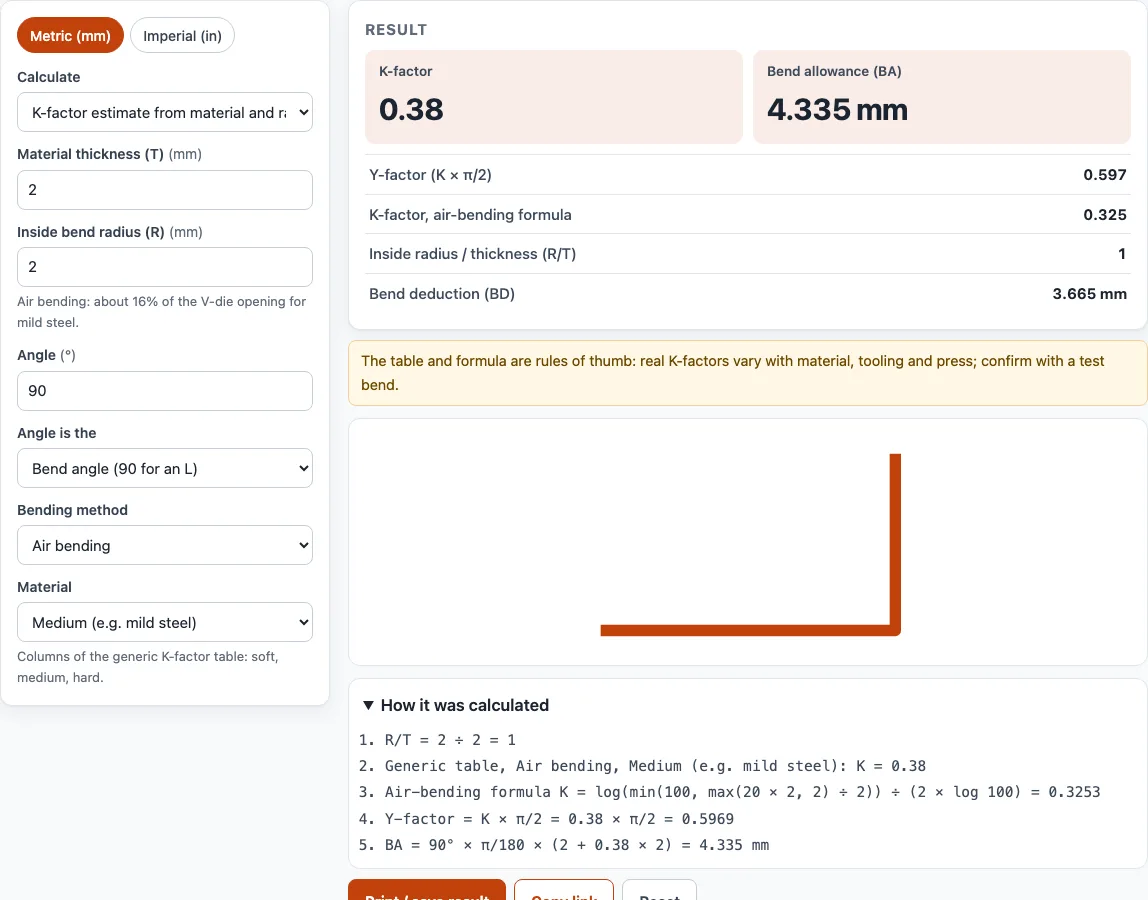
How to use the K-factor calculator
- Choose your units with the ‘Metric (mm)’ / ‘Imperial (in)’ switch at the top of the tool.
- In the ‘Calculate’ list, keep ‘K-factor estimate from material and radius’ selected. This is the mode that opens on this page.
- Enter the ‘Material thickness (T)’.
- Enter the ‘Inside bend radius (R)’.
- Enter the ‘Angle’ of the bend.
- Pick a ‘Bending method’: Air bending, Bottoming or Coining.
- Pick a ‘Material’: Soft (e.g. aluminum), Medium (e.g. mild steel) or Hard (e.g. hard steel).
- Read the results: the K-factor from the generic table, the Y-factor, the K-factor from the air-bending formula, R/T, and the Bend allowance (BA) and Bend deduction (BD) for your angle.
- Check the warning under the result: the table and formula are rules of thumb, so treat the K-factor as a starting value.
- Once you know K, switch the ‘Calculate’ list to ‘Flat length of a bent part’ and type your K into the ‘K-factor’ box to get the blank size.
Under the result, ‘Print / save result’ prints your inputs, results, calculation steps and the date. Use your browser’s Save as PDF option to keep a PDF. ‘Copy link’ reopens the page with the same inputs, which is useful for sharing. ‘Reset’ clears the form.
What is the k factor in sheet metal?
When sheet metal bends, the inside of the bend is compressed and the outside is stretched. Between them lies the neutral axis, whose length does not change. The K-factor is the position of that axis: K = t / T, where t is the distance from the inside face of the bend to the neutral axis and T is the material thickness. K normally lies between about 0.3 and 0.5. This is the sheet metal K-factor only, not a flow meter K-factor.
What is the k factor formula in sheet metal?
The bend allowance formula is BA = A × π/180 × (R + K × T), where A is the bend angle in degrees and R is the inside radius. The Y-factor is K × π/2, the form some CAD programs use for the same information.
The tool’s generic table is a rule of thumb that depends on the bending method, material and R/T ratio. For air bending of medium steel, it gives 0.38 up to R/T of 1, 0.43 up to 3, and 0.50 above 3.
What is the sheet metal bending formula for the k factor?
For air bending, a formula from the same source is K = log(min(100, max(20 × R, T) / T)) / (2 × log 100). It gives 0.325 at R = T, 0.400 at R = 2T, and 0.5 from R = 5T upward.
For example, take 2 mm mild steel with R = 2 mm in a 90° air bend. The R/T ratio is 1, the table K-factor is 0.38 (Y-factor 0.597), the formula K-factor is 0.325, BA is 4.335 mm and BD is 3.665 mm.
How to calculate the k factor from a test bend?
- Cut a strip and measure its flat length before bending.
- Bend it once at your chosen radius and angle.
- Measure both outside flanges, L1 and L2.
The tool then works out BD = L1 + L2 − flat, then BA = 2 × OSSB − BD, where OSSB is the outside setback, (R + T) × tan(A/2). Finally, K = (BA / (A × π/180) − R) / T. For a 2 mm sheet bent 90° at R = 2 mm, with flanges of 50 mm and 30 mm and a flat blank of 76.3 mm, the result is K = 0.369.
Generic K-factor table
The table the tool uses for its estimate is a rule of thumb, and real values can differ a lot. K by method, material class and R/T:
| Method and material | R/T up to 1 | R/T over 1 to 3 | R/T over 3 |
|---|---|---|---|
| Air bending, soft (e.g. aluminum) | 0.33 | 0.40 | 0.50 |
| Air bending, medium (e.g. mild steel) | 0.38 | 0.43 | 0.50 |
| Air bending, hard | 0.40 | 0.45 | 0.50 |
| Bottoming, soft (e.g. aluminum) | 0.42 | 0.46 | 0.50 |
| Bottoming, medium (e.g. mild steel) | 0.44 | 0.47 | 0.50 |
| Bottoming, hard | 0.46 | 0.48 | 0.50 |
| Coining, soft (e.g. aluminum) | 0.38 | 0.44 | 0.50 |
| Coining, medium (e.g. mild steel) | 0.41 | 0.46 | 0.50 |
| Coining, hard | 0.44 | 0.47 | 0.50 |
Sources
Data and rules used by this tool (checked October 2026):
Frequently asked questions
Is the K-factor from this calculator exact?
No. The table and formula are rules of thumb. Real K-factors depend on the material, tooling and press, so confirm important parts with a test bend.
What K-factor should I use for stainless steel?
The table has only three material classes, soft, medium and hard, and no stainless entry. Pick the class closest to your material, read the value for your R/T ratio, and check it with a test bend before you release a production part.
What is the difference between K-factor and Y-factor?
Both describe the same neutral axis position. The Y-factor is K × π/2, and it is the form some CAD programs use.
Can I use the result to get the flat blank length?
Yes. Switch the ‘Calculate’ list to ‘Flat length of a bent part’, type your K into the ‘K-factor’ box and enter the flange lengths. The bend allowance calculator page has the same modes.
Is this the K-factor of a flow meter?
No. This page is the sheet metal K-factor, the position of the neutral axis in a bend. It does not calculate flow meter pulses per unit volume.
Is my data sent anywhere when I use this tool?
No. Everything runs in your browser, and nothing you type is sent anywhere.
Related tools
- Bend allowance calculator: use it to get the flat length of a bent part once you know your K-factor.
- Bend radius calculator: use it when you need to choose or check the inside bend radius before you bend.
- Sheet metal gauge chart: use it to look up material thickness by gauge number before you enter T.
- Cone flat pattern calculator: use it to lay out the flat pattern for a cone-shaped part.
- Laser cut box generator: use it to create laser-cut box patterns that you then fold.
- Laser cutting cost calculator: use it to estimate what cutting your flat parts will cost.