Steel Beam Weight Calculator
Enter the depth, flange and web dimensions of an I-beam or H-beam to get its weight per foot or metre and the weight of each beam.
The steel beam weight calculator works out how much an I-beam, H-beam or W-beam weighs from its section dimensions and length. Enter the depth, flange width, flange thickness, web thickness and length, and it returns the weight of one piece and the total for your order. It is a free metal i beam weight calculator that runs in your browser, with nothing to install and no sign-up.
Use it for a quick estimate when you are preparing a quote, planning a delivery load, or writing a material list. The same weight calculator also covers plate, pipe and other shapes. This page opens with I-beam / H-beam / W-beam in mild steel selected. Channel (C) and angle (L) sections are in the same Shape menu if your member is different.
Results are for estimation. For structural design, check against the applicable standard and supplier data.
At a glance
Steel Beam Weight Calculator is a free browser tool that takes the depth, flange width, flange and web thicknesses and length of an I-beam or H-beam and returns its weight per metre or foot and the weight of each piece.
- The I-beam area is 2 × bf × tf + (d − 2 × tf) × tw.
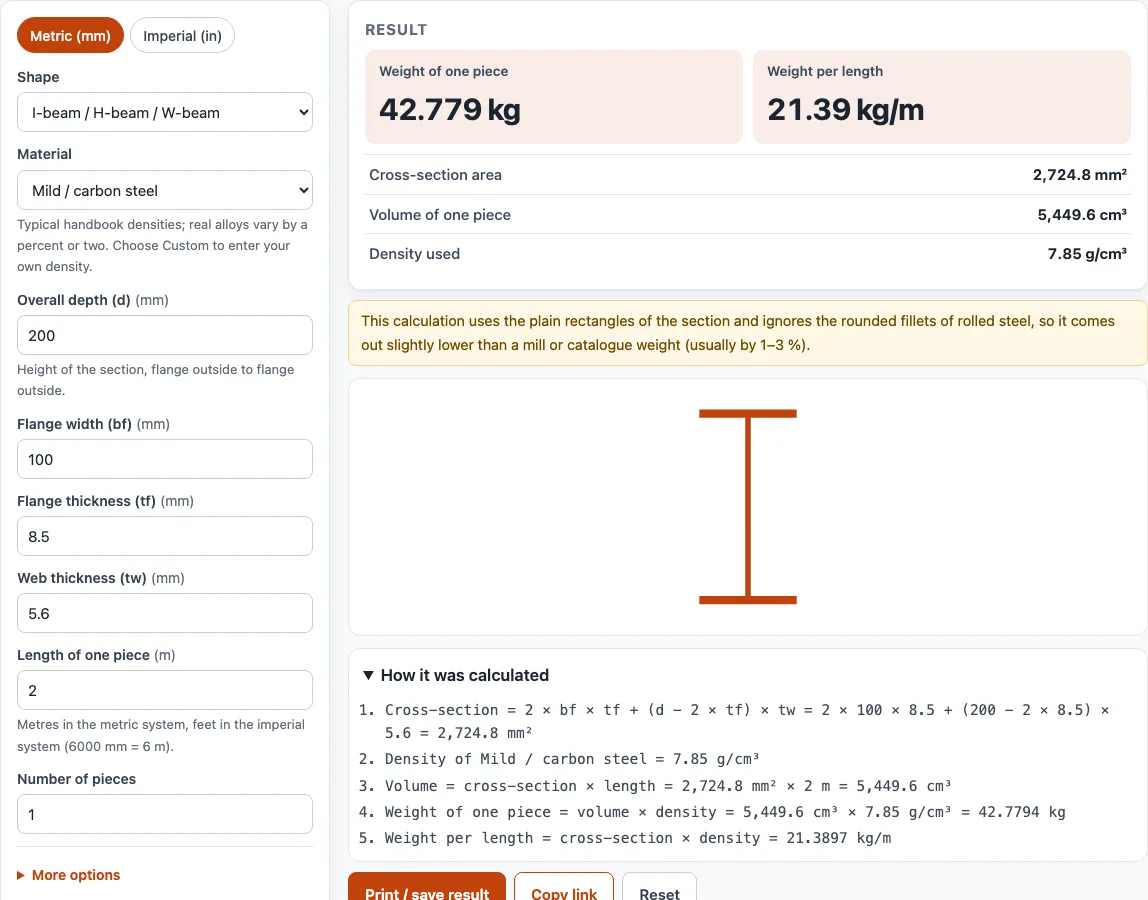
- With d 200, bf 100, tf 8.5 and tw 5.6 mm, the area is 2,724.8 mm², which gives 21.39 kg/m, so a 6 m piece weighs 128.3 kg.
- Entering d 8.00, bf 8.00, tf 0.435 and tw 0.285 inches gives 30.60 lb/ft for a W8×31, slightly under its catalogue weight of 31 lb/ft.
- Structural sections are calculated without the rolled fillets, which is why the result can sit a little under the catalogue figure.
- The tool calculates weight only, not stresses, deflection or load capacity, which need a structural engineer.
Sources: I-beam (Wikipedia) (checked 2026-10-15) · W8x31 Beam Specifications (EngineerExcel) (checked 2026-10-15)
How to use the steel beam weight calculator
- Pick your units with the Metric (mm) / Imperial (in) switch at the top of the tool.
- Check that Shape is set to I-beam / H-beam / W-beam. The page opens this way, so only change it if you need another shape.
- Confirm the material is mild/carbon steel, the default for this page.
- Type the overall depth (d) of the beam, measured from the outside of one flange to the outside of the other.
- Type the flange width (bf).
- Type the flange thickness (tf).
- Type the web thickness (tw).
- Enter the length of one piece in metres or feet.
- Enter the Number of pieces.
- Optional: open More options and type a price per kg or per lb to get a material cost.
- Read the results: weight of one piece, total weight, weight per length (kg/m or lb/ft), cross-section area, volume and density used. The cross-section sketch and calculation steps show how the numbers were reached.
Use Print / save result to print the inputs, results, calculation steps and date. In the print dialog, choose Save as PDF to keep a PDF copy. Copy link gives you a link that reopens the page with the same inputs, and Reset clears the form.
How to calculate the weight of a steel beam
The weight of a steel beam is its cross-section area multiplied by its length and by the density of the metal. Keep units consistent: square millimetres for area, metres for length, and kilograms per cubic metre for density. Mild steel has a density of 7.85 g/cm³, which is 7,850 kg/m³.
For an I-beam, the area is 2 × bf × tf + (d − 2 × tf) × tw. The two flanges make up the first part, and the web between them makes up the second. With d 200, bf 100, tf 8.5 and tw 5.6 mm, the area is 1,700 + 1,024.8 = 2,724.8 mm². That is 0.0027248 m², so the weight per metre is 0.0027248 × 7,850 = 21.39 kg/m. A 6 m piece weighs 128.3 kg.
What does W8x31 mean
W8×31 is a wide-flange designation. The W means the beam has wide, parallel flanges. The 8 is the nominal depth in inches, and the 31 is the nominal weight in pounds per foot. So a W8×31 is about 8 inches deep and weighs 31 lb per foot.
You can check this with the tool using the Imperial units. Entering the AISC dimensions d 8.00, bf 8.00, tf 0.435 and tw 0.285 inches gives 30.60 lb/ft, which is close to the 31 lb/ft designation.
What is the self weight of a steel beam?
The self weight of a beam is its dead load, meaning the weight of the beam itself. It equals weight per length multiplied by span. Using the worked example above, a beam at 21.39 kg/m over a 6 m span has a self weight of 128.3 kg.
The tool calculates weight only. It does not work out stresses, deflection or load capacity. Those depend on the loads, supports and steel grade, and they need a structural engineer and the applicable design code.
Channels and angles
The same tool weighs other structural shapes. Choose Channel (C) and enter the depth, flange width, flange thickness and web thickness, or Angle (L) and enter both legs and the thickness; the area formula for an angle is t × (a + b − t).
Sources
Data and rules used by this tool (checked October 2026):
Frequently asked questions
Why is my result a little lower than the catalogue weight?
Structural sections ignore the rolled fillets, which are the curved joins between the web and flanges. This is why the result is slightly under the catalogue weight, for example 30.60 lb/ft against 31 lb/ft for a W8×31. For ordering, use the catalogue weight. The tool result is suitable for estimates.
Can I use the results in commercial work?
Yes. Results and files may be used in quotes, client jobs and products you sell, royalty-free, with no attribution required. The only limit is copying the site itself as a competing service.
Is anything I type sent to a server?
No. Everything runs in your browser, and nothing you type or upload is sent anywhere.
Can I switch to imperial units or a different material?
Yes. Use the Metric (mm) / Imperial (in) switch at the top of the tool to change units. The material list includes common metals, and Custom density lets you enter any density you need.
What is the difference between an I-beam and an H-beam?
Both have two flanges joined by a web. An H-beam (wide-flange) has flanges about as wide as the section is deep, while an I-beam has narrower flanges; American Standard S-shapes also have tapered flanges. The tool assumes parallel flanges of constant thickness, which matches W and H sections best.
How much does a W8x31 beam weigh?
Its designation says it: about 31 lb per foot, so a 20 ft W8×31 weighs about 620 lb. From its dimensions the tool gives 30.60 lb/ft (612.0 lb for 20 ft) because it leaves out the rolled fillets.
Related tools
- Steel plate weight calculator: use it when you need the weight of flat plate or sheet steel by width, thickness and length.
- Pipe weight calculator: use it for pipe sizes set by NPS and schedule.
- Metal weight calculator: use it for bars, tubes and other shapes that are not beams.
- Sheet metal gauge chart: use it to look up sheet thickness by gauge number before you calculate plate weight.
- Stainless steel gauge chart: use it to find stainless sheet thickness by gauge.
- Laser cutting cost calculator: use it to estimate the cost of cutting the parts you have weighed.
- Angle iron weight calculator: use it for equal and unequal angles.