Steel Coil Weight Calculator
Enter the coil outside diameter, core diameter and strip width to get the coil weight, or enter the weight to get the outside diameter.
A steel coil weight calculator estimates how much a coil of steel strip weighs from its outside diameter, inside diameter, strip width and material density. This free browser tool works out the coil weight, the length of strip on the coil and the strip weight per metre. It needs no sign-up, and nothing you enter is sent anywhere.
Use it when you are checking a supplier’s coil weight, planning a load, or estimating how much strip a coil holds. You can switch between metric (mm) and imperial (in) units, and choose from common metals such as mild steel, stainless 304 and 316, aluminum, copper and titanium. For any other alloy, enter your own density.
The result is an estimate based on the strip geometry. Confirm the weight against the mill certificate or a scale before you invoice, buy or lift the coil.
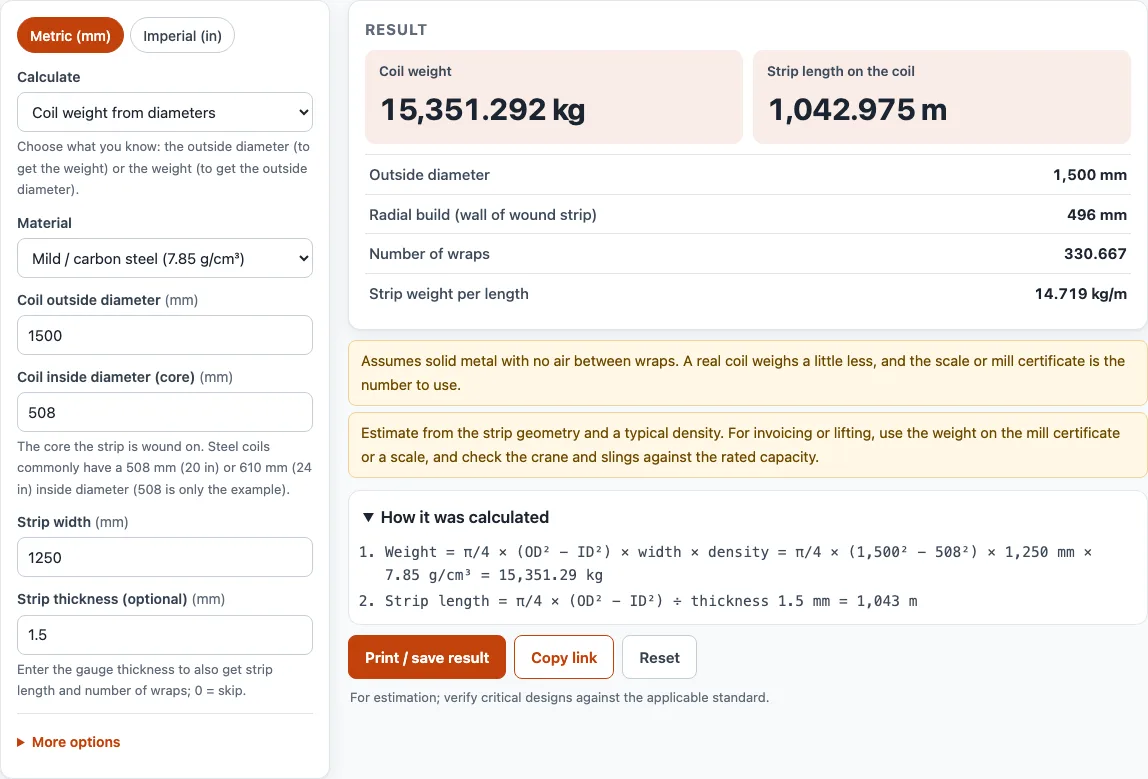
How to use the steel coil weight calculator
- Pick your units with the Metric (mm) / Imperial (in) switch at the top of the tool.
- In the Calculate list, choose “Coil weight from diameters” if you know the diameters, or “Outside diameter from coil weight” if you know the weight and need the diameter.
- Set Material. Choose mild/carbon steel, stainless 304 or 316, or another metal from the list. For an alloy that is not listed, choose Custom density and type in its density.
- Enter the Coil outside diameter.
- Enter the Coil inside diameter (core). Check the core size on the coil tag. Steel coils commonly use a 508 mm (20 in) or 610 mm (24 in) core.
- Enter the Strip width.
- Optionally, enter the Strip thickness. Doing so also shows the Strip length on the coil, the Number of wraps and the Strip weight per length.
- Open More options and set Winding fill. Leave it at 100 percent for solid metal, or lower it to allow for air gaps between wraps.
- Read the results: Coil weight, Strip length on the coil (when a thickness is entered), Outside diameter, Radial build (wall of wound strip) and Strip weight per length. The steps list below shows the working, so you can check each figure.
Switch units before you enter numbers, so every value is read in the system you expect. Use Custom density for an alloy that is not on the list.
How do I calculate the weight of a steel coil?
A tightly wound coil is a hollow cylinder, so its weight is π/4 × (OD² − ID²) × width × density. OD is the outside diameter, ID is the inside diameter (the core), and density is the metal’s density.
For a steel coil with a 1,500 mm outside diameter, a 508 mm core and 1,250 mm width, the metal’s cross-section is about 1.56 m². Multiplying by the width gives about 1.96 m³ of steel. At 7,850 kg/m³, that weighs about 15,351 kg.
How long is the strip on a coil?
The strip length is π/4 × (OD² − ID²) ÷ thickness. The width cancels out: the coil’s volume is the ring area times the width, and the strip’s cross-section is the width times the thickness, so dividing one by the other leaves the ring area divided by the thickness.
Using the same coil with 1.5 mm strip, the length is about 1,043 m. That is about 331 wraps, found from the radial build (496 mm) divided by the thickness. The strip weighs about 14.72 kg per metre.
In imperial units, a coil with a 60 in OD, 20 in ID and 0.06 in thick strip holds about 3,491 ft of strip.
How do I find the outside diameter from coil weight?
Rearrange the formula to get OD = √(ID² + 4 × weight ÷ (π × width × density)). You need the weight, inside diameter, width and density.
The same coil at 15,000 kg has an outside diameter of about 1,484.7 mm. Use the “Outside diameter from coil weight” mode to do this calculation without working it out by hand.
Sources
Checked October 2026:
- AIMS Industrial, material density chart (steel 7.85 g/cm³, stainless 8.00, aluminum, copper, brass, titanium and more)
- Goodluck India, galvanised coils (coil inner diameter 508 mm / 610 mm) and Reroy Group, cold-rolled coil line (508 / 610 mm inner diameter), two suppliers’ specifications for the common core sizes
- Wikipedia, Annulus (area of a ring, π/4 × (OD² − ID²))
Frequently asked questions
What density should I use for stainless steel?
The tool uses 8.00 g/cm³ for stainless 304 and 316. Choose the matching material from the Material list. If your supplier gives a different density, use Custom density.
What does winding fill do?
Winding fill reduces weight and strip length in proportion to the air gaps between wraps. The default of 100 percent assumes solid metal, so the result is the upper bound.
What core size do steel coils usually have?
Steel coils commonly come on a 508 mm (20 in) or 610 mm (24 in) core. Check the coil tag for the exact inside diameter, since it is the value that gives the most accurate result.
Can I work out strip length as well as weight?
Yes. Enter the strip thickness and the tool also gives the strip length on the coil, the number of wraps and the strip weight per metre or foot. Leave the thickness at 0 to skip them.
Does it work for aluminum, copper or stainless coils?
Yes. Pick the material from the list, or choose Custom density and type the density of your alloy. The formula is the same for every metal; only the density changes.
Can I use this result for invoicing or lifting?
The result is an estimate from the strip geometry. For invoicing, use the weight on the mill certificate or a scale. For lifting, check cranes and slings against their rated capacity.
Related tools
- Metal weight calculator: use it to estimate the weight of metal shapes when you are not working with a coil.
- Steel plate weight calculator: use it to find the weight of flat steel plate from its size and thickness.
- Round bar weight calculator: use it to estimate the weight of solid round bar.
- Pipe weight calculator: use it to estimate the weight of pipe from its diameter and wall thickness.
- Sheet metal gauge chart: use it to look up sheet thickness by gauge number before you enter a strip thickness.
- Laser cutting cost calculator: use it to estimate cutting costs once you know the material and part size.